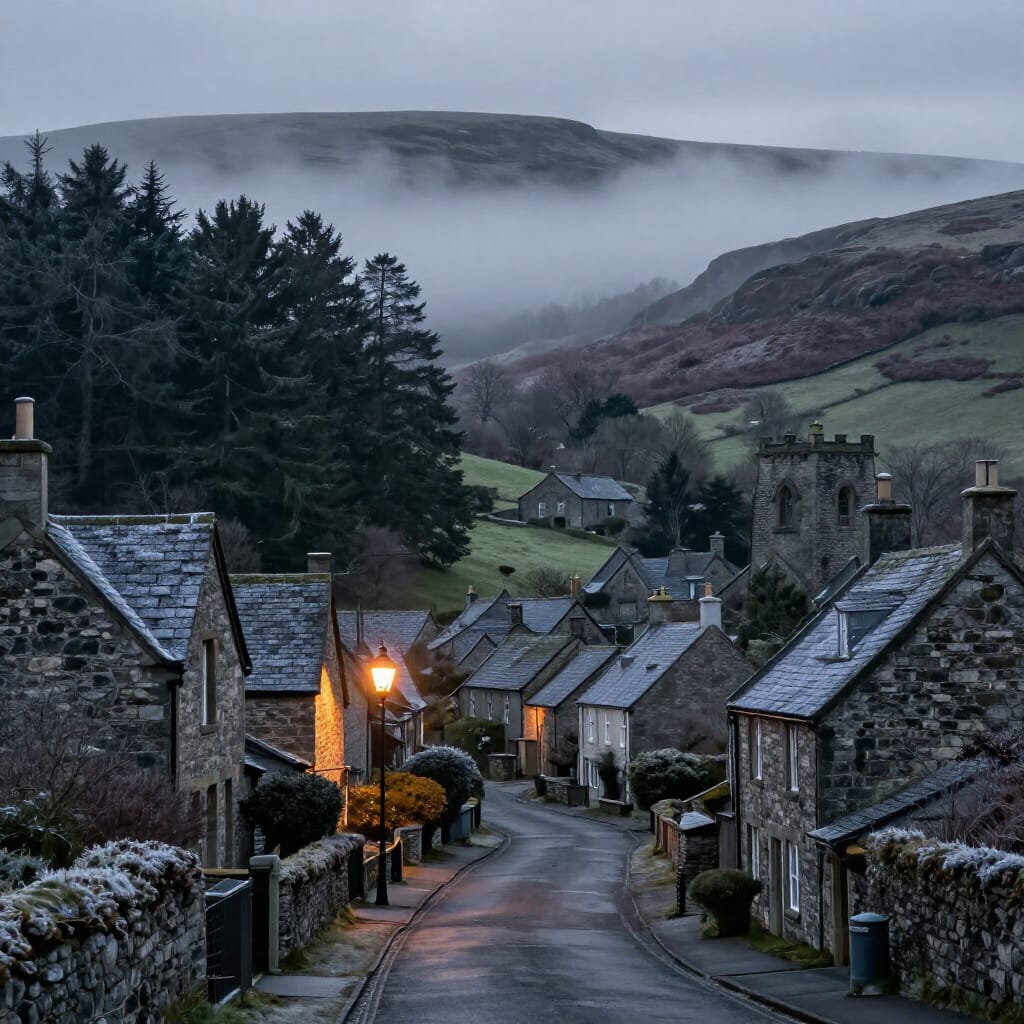
History & Significance
Hope's End has, in Toby Knight's words, "more history than most villages." The remark is made lightly, in the context of a home-school history lesson, but it carries weight that the saga earns over time. The village sits within a wider pattern of anomalous activity across the Peak District — incidents reaching back at least to the First World War, when file fragments recovered decades later describe towns going "sideways for a fortnight at a time," men disappearing into cellars on home leave, and vicars hanging themselves after a week of confessions they couldn't repeat.
The Knight family did not originate in Hope's End. Ben and Toby relocated here from the coast — over 200 miles from Shoreham, where the events of 16 October 1987 destroyed a hospital and killed over 700 people — at the direction of their mother, in a letter that gave only an address: 13 Haversage Road, Hope's End, Derbyshire. The choice of location was deliberate. Whether it was chosen for its remoteness, its history, or something less easily named, the saga does not yet fully answer.
By 1995, Hope's End is the active base of operations for Ben Knight's Beowulf field assignment, with Declan Marsden operating in parallel as an independent Beowulf asset. The village is under passive surveillance from multiple agencies. By late 1999, Orion operatives have returned to Derbyshire. A static relay has been identified near Edale Cross — listening but not yet transmitting.
"Hope's End was not quiet. It was broadcasting. And something out there had just answered."
— Declan Marsden. Cambion
Five confirmed anomalous incidents occur within forty miles of Hope's End in the six weeks following Robert Knight's first major manifestation in November 1995 — Derby, Matlock, Bakewell, Chesterfield, Sheffield — each associated with the circulation of a coin bearing unusual properties linked to the entity Mammon. The pattern tightens inward towards Hope's End with each incident. This is not coincidence.
Key Locations
The Knight family home. A stone terraced house whose interior is characterised by the rhythms of three people navigating each other carefully: the kitchen with its perpetually unreliable fridge and the clock on the wall that reads 00:07 regardless of the time, the living room with its worn carpet path between sofa and door, the landing where Toby's bedroom door occasionally stands ajar. The house was identified by the Knights' mother as the destination in her final letter and has been the family's base since 1987. It is also, quietly and persistently, one of the most anomalously active addresses in the village.
The village primary school, its limestone walls dulled beneath decades of grime and bird droppings, its wire-fenced playground backed by northern peaks and dark evergreens. It is here, in November 1995, that Robert Knight's first confirmed manifestation occurs — a single punch that knocks a tooth from Michael Lawson and registers in Declan Marsden's field log as a gold ocular event with unnatural strength demonstrated. The incident is logged, buried across three departments, and becomes the trigger for everything that follows.
The only pub in Hope's End. Its name references both the valley's railway history and the reservoir that drowned the settlements below — a framed map above the dartboard still shows the villages that no longer exist. Horse brasses line the walls, their gilt worn to shadow. The landlord is Mick Hargreaves, whose scarred knuckles suggest a past that doesn't require elaboration. The pub functions as an informal meeting point for the village's adult network — including, on occasion, Declan Marsden.
A red telephone box at the edge of the High Street, its glass panels starved of light, its red paint scabbed down to grey primer. Used by operatives for secure communications via a rotating six-digit number that changes weekly. The box functions as a dead drop and relay point in the village's surveillance geography, its anonymity preserved by its ordinariness.
The high ground above Hope's End, where the valley unfurls behind the walker in a patchwork of green and grey. Robert comes here in the aftermath of the events of Book One — walking the hills alone, watching a crow work at the scorched margin of a field below, turning the word abomination over in his mind until its meaning unravels into nothing. The hills look exactly the same as they always have. This, in its way, is the most unsettling thing about them.
The Post Office & Village Green
Peripheral landmarks of the village's ordinary life — the post office on the High Street, the church rising behind the green, two women pausing mid-sentence in the churchyard. These details accumulate into a picture of a community that functions normally on its surface and has learned not to look too hard at what moves beneath it.
Supernatural Status
Hope's End occupies an unusual position within the cosmology of the saga. It is not a place of inherent power in the manner of Glastonbury or other mythologically charged locations — it is, rather, a place that has become significant through accumulation. The presence of Robert Knight since infancy has made it a focal point: a location that registers on whatever frequency the entities known as the Seven are tuned to.
The electrical anomalies that accompany Robert — clocks freezing at 00:07, televisions activating without contact, radios failing — are most concentrated in and around the family home, but have been observed more broadly across the village in proximity to Robert's emotional extremes. Whether this represents environmental contamination, a widening of Robert's field of influence, or something older in the land itself responding to his presence, is not resolved within Book One.
What is established is this: multiple intelligence agencies, at least one entity of ambiguous allegiance, and at least one of the Seven are all aware of Hope's End by 1995. The village's days as a containment site — a place chosen precisely because nothing happened there — are numbered.
Trivia
- The village name is not explained within the text, but functions as both a geographical descriptor — the valley road ends here — and a thematic one. "Hope's End" in the context of the saga carries the weight of things that stopped being possible.
- The Knight family's address — 13 Haversage Road — was provided by their mother in her final letter, written hours before her death. She chose the house. Neither Ben nor Toby have ever fully explained why they trusted the instruction.
- The reservoir that gives the pub its name drowned several villages. Their names survive only on the framed valley map above the dartboard in The Rail & Reservoir. The book does not name them.
- Hope's End sits approximately 200 miles inland from Shoreham, West Sussex — the site of the 1987 hospital incident in which Robert was born and his mother died. The distance was deliberate.
-
Toby Knight's observation that Hope's End "has more history than most villages" is made to Robert during a home-school history lesson, immediately before producing a copy of Englaland: An Age of Broken Kings — a book that, within the Aethereal Stories universe, is a chronicle of the period immediately preceding the events of the saga's deeper mythological history.
Appearances