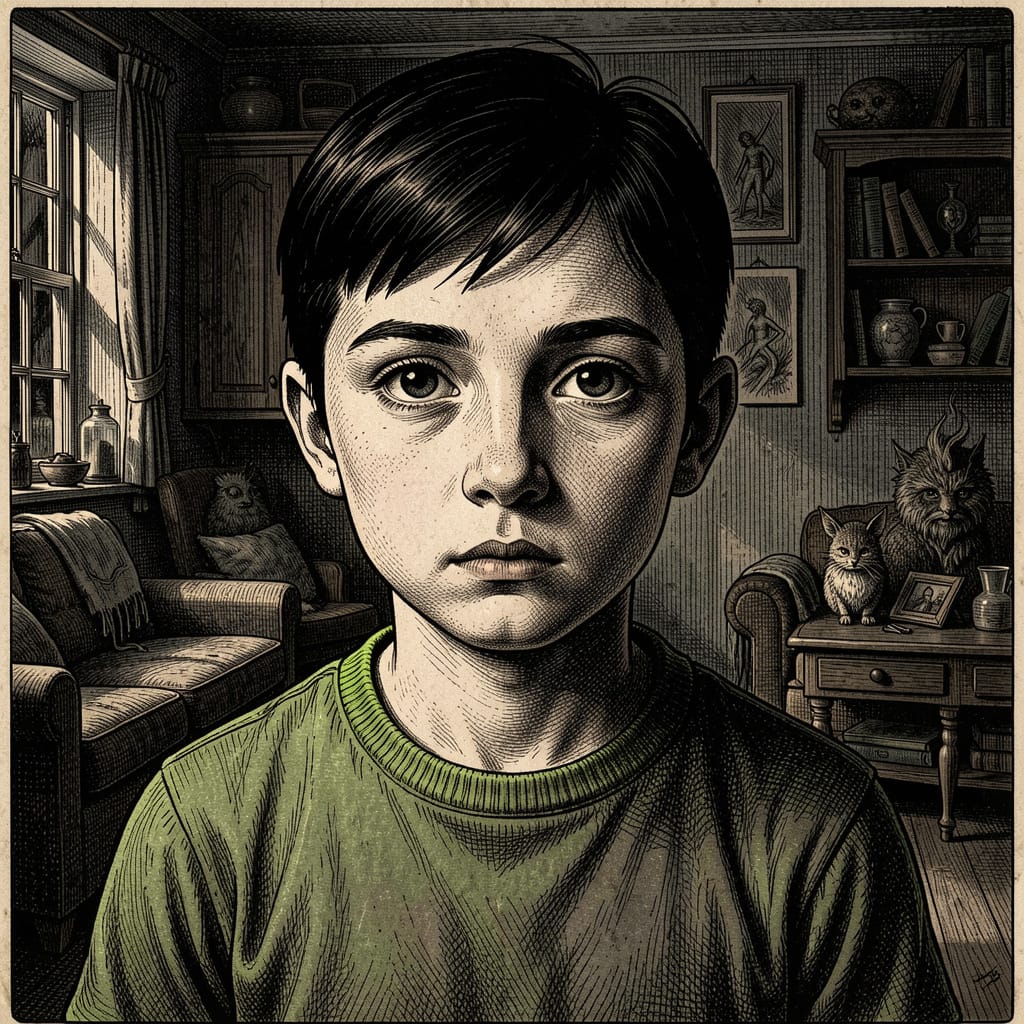
"He's still Rob." · Primary Witness · The One Who Shows Up
Overview
Daniel Marsden was placed beside Robert Knight at Stepping Stones Primary on the first day of school by his father Declan Marsden, with the instruction to befriend Robert, stick close, and make people see what he was told to see. Daniel has long since transcended this origin. He is the closest thing to a second protagonist in Book One — the person who witnesses everything, understands more than anyone accounts for, and arrives at conclusions that neither the adults around him nor the institutions they serve expected from a fourteen-year-old.
He is the primary witness to the November 1995 schoolyard incident, bound by non-disclosure agreement. He is the investigator who connects the Mammon coin pattern, dissects the Binsfeld taxonomy, works through the Nephilim hypothesis and crosses it out, tracks the disappearance clusters across a world map, and ends the book with a single equation — Pink + Gold = ? — and an answer written in clean hard capitals beneath it. He is also the boy who, when he saw Robert's hand pressed to the glass, pale and small, thought: He's still Rob — and rode home pedalling hard enough that the cold air burned his lungs.
Appearance
Daniel advances in neat, measured strides, his jumper smoothed flat against his chest, his collar folded with military care — save for a single, defiant lime-green cuff. The lime-green cuff is the book's first image of him, and its most precise: someone who keeps everything orderly and allows himself one anomaly. He is his father's son in his cataloguing instinct and his tactical calm, and not his father's son in the quality of his loyalty.
✦
Personality
Daniel is steady in the way that people trained to observe rather than react become steady — not passionless, but disciplined, the emotions present and registered and not permitted to override the decision. He steps in front of Mrs Jenkins and says I was involved — a clean, deliberate lie — without looking at Robert, without hesitation, because the calculation is instant and the answer is obvious. He does not perform heroism. He just shows up.
He is methodical. The shoebox of index cards, the colour-coded system inherited from his father's operational habits, the red biro circles around dates and incidents — these are the tools of a boy who learned to sort information before he knew why he was doing it, and who has turned that habit towards a private investigation his father does not know he is conducting. He is also, beneath the methodology, deeply and specifically loyal. His investigation is always, underneath, about the same question: what is happening to Robert, and what can be done about it.
The Nephilim hypothesis is the book's clearest window into Daniel's character. He writes the word. He circles it. Four or five seconds of something close to satisfaction — the feeling that the pattern has finally resolved, that a monster with rules is better than something without them. Then he understands what that satisfaction says about him. What he has been hoping for. He drives the marker back and forth until the word is obliterated. He was hoping for a monster because a monster can be handled. The data doesn't care what he wants.
History & Background
Daniel grew up in Hope's End in the household of a Beowulf operative, absorbing his father's three rules for living in a quiet village before he could articulate why they were rules rather than ordinary advice. His mother Helen Marsden died when he was barely two — killed in March 1989 in Shoreham-by-Sea three weeks after filing the report that named what Robert Knight really was. He finds the article himself in a local archive, reading it from the bottom up the way his father taught him. He reads it. He reads what extended duration means. He winds the microfilm forward to the photograph — not his mother's face, just her collarbone — and looks at it for a long time.
He is bound by non-disclosure agreement following the November 1995 incident — a legal constraint imposed on an eight-year-old, which Declan arranged within twenty-four hours of the event. The NDA does not stop him investigating. It stops him telling anyone what he finds.
Daniel functions in Book One as the reader's most reliable point of access to events — the observer who has been trained to watch without bias and who nonetheless keeps arriving at conclusions that feel personal. He witnesses the gold shift. He manages the teacher at Stepping Stones and tells Toby the truth in two words — he doesn't remember — at the precise moment it needs to be said. He spends months separated from Robert by adult decisions, rides to the end of Robert's lane, and raises one hand at the window. I see you. He rides away. He does not stop watching.
His private research runs parallel to the book's institutional plot — the same events, from the ground, without access to the files, through inference and index cards and a shoebox his father doesn't know he has opened fully. He draws his own map. He makes his own connections. He obliterates the Nephilim hypothesis and keeps working. The equation he arrives at — Pink + Gold = ? — refers to a pattern of disappearances converging on England from Australia, with one name in the data: Laura Dai, age 15, one-way, Manchester. He writes his answer beneath the equation in the same clean hard capitals he uses when he wants something to stay:
"When two fires meet, they do not cancel. They feed each other. They build."
— Daniel Marsden, written on a map. Cambion
Further saga details — spoilers beyond Book One
Daniel and Robert are the central protagonists of Books Two, Four, and Five. Beauty and the Beast Within introduces Laura Dai — the Pink to Robert's Gold — and the two fires Daniel has been tracking finally meet. Details forthcoming.
The friendship Daniel was assigned and chose. He was placed beside Robert as a surveillance asset and became the only person with whom Robert can attempt speech without it costing him something. When the assignment and the friendship pull against each other — when the word cambion is in the room and Daniel knows what it means — he looks at Robert's hand pressed to the glass, pale and small, and pedals home thinking: He's still Rob. This is the book's central emotional position, and it is Daniel's. He arrives at it on a bicycle and holds it for the remainder of the saga.
Daniel's father and the source of both his training and his damage. Declan gave him the three rules, the shoebox system, the habit of watching, and the instruction to make people see what he was told to see. He also gave him an impossible position from the age of five and called it friendship. Daniel's response — telling his father he doesn't want to report on Robert, he just wants to be his mate — is the cleanest statement of character in the book. He is his father's son in method and not in allegiance.
Daniel's mother, who died when he was barely two. He finds her in a microfilm archive — not her face, just her collarbone, just the mark on it — and reads what extended duration means. He knows the date already: 7 March 1989, the margin date, his date, the one with the triangle in the corner. He does not tell his father what he has found. He keeps it in the shoebox, like everything else.
Quotes
"I was involved." [The lie landed clean.]
— Daniel Marsden, to Mrs Jenkins. Cambion, Chapter One
"He doesn't remember. The fight — it's gone. He doesn't know how he did it. Don't make him explain."
The lime-green cuff is the book's first image of Daniel — one anomaly in an otherwise precise presentation. It is never explained. It doesn't need to be. It is the detail that says everything the prose leaves unsaid about who Daniel is beneath the discipline.
Daniel's three rules — his father's rules, absorbed before he was old enough to know they were operational briefings — frame the opening chapter and recur throughout. The third rule is the one that matters at the moment the gold shifts in the playground: if something isn't human, you treat it like it's loaded. Daniel does not treat Robert like it's loaded. He steps in front of Mrs Jenkins and says he was involved.
The Nephilim hypothesis is circled, held for four seconds, and obliterated. What Daniel understands in those four seconds — that he wanted a monster because a monster has rules, and that this wanting says something about him he does not like — is the book's most precise rendering of the difference between knowledge and wisdom. He is fourteen.
The shoebox of index cards is inherited from Declan's operational habits — the same colour-coding system, the same typewritten headings. Daniel uses it for something his father has not sanctioned and does not know about. The tool passes from father to son and is turned against the father's interests. This is never commented on in the text.
Daniel finds his mother in a microfilm archive — not because he was looking for her, but because a Derbyshire newspaper from the right date leads him to a West Sussex death notice, and the date matches the margin date in his father's files. He reads it from the bottom up, the way his father taught him. He reads what the injuries mean. He looks at the photograph for a long time. He does not tell Declan what he found.
The equation Pink + Gold = ? written on the world map at the book's close is the first hint of Book Two's central relationship. Pink is Laura Dai. Gold is Robert. Daniel has been tracking her disappearance route across Australia for eleven days through forwarded emails from a source his father doesn't know he has. He closes the laptop. He writes the answer in hard capitals. Then he sits in the reduced light and doesn't move.
Soundtrack
♪
Cambion: The Official Soundtrack — Track TBC
Consensus Reality — Daniel's theme. The title is lifted directly from his father's instruction: reality's only what people agree to believe. For Daniel, raised on this principle and required to apply it to his closest friend, it is not a cynical observation but a burden — the specific weight of knowing what you have seen and being bound, by agreement and by love, to manage what others make of it. Part of the full soundtrack, releasing 1 May 2026 via Aethereal Stories on all major streaming platforms.